The Fascinating Story of Banarasi Sarees
By Singhanias Hyderabad
The Fascinating Story of Banarasi Sarees
Attention fashion lovers! Ever wondered how the magnificent Banarasi saree became one of India’s most celebrated and desired textiles? With its beautiful heritage, rich craft legacy, and breathtaking handwoven artistry, the Banarasi saree has captured the hearts of women for generations. Join us as we explore the incredible journey of this timeless drape—its origins, weaving techniques, and the magic behind its luxurious beauty.
Banaras stands as a canvas of vibrant colors and artistic brilliance. There is something mystical and almost dreamlike about a Banarasi saree. The true essence of its legacy lies in the finesse of its weaving technique. Each weave reveals something new—lush floral motifs, delicate patterns, and captivating detailing that reflect centuries of skilled craftsmanship.
Origin and Weave of the Banarasi Saree
The legacy of Banarasi silk dates back to the Mughal era, when Varanasi emerged as a thriving hub for luxury textiles. It is believed that Emperor Akbar played a pivotal role in promoting and refining the Banarasi weaving tradition. The Mughals contributed significantly to the evolution of intricate motifs, exquisite zari work, and ornamental design elements that are now synonymous with Banarasi sarees.
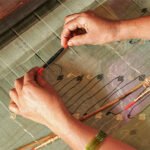
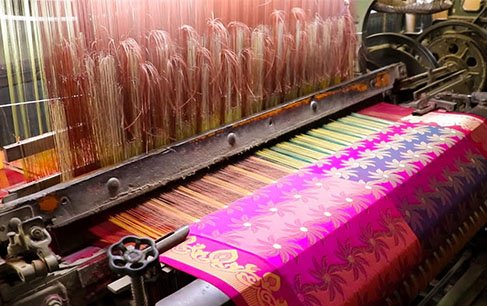
The weaving process is just as mesmerizing as the final masterpiece. Banarasi fabrics are woven using grand Jacquard looms, comprising around 5600 threads arranged across a 45-inch width. The weaving rhythm is created by the interplay of the *warp* and *weft* threads, building the desired patterns stroke by stroke.
The process begins with artists sketching designs on graph paper, experimenting with color themes, motifs, and layout concepts. From these designs, hundreds of punched cards are created, which guide the loom to weave precise patterns—each card representing a portion of the design. Together, they bring life to the beautiful motifs woven into the fabric.
Features of Banarasi Sarees
Banarasi sarees are among India’s most admired drapes, celebrated for their heritage and exceptional craftsmanship. Historically, they were worn by royalty during grand ceremonies, weddings, and festive occasions, symbolizing status, wealth, and refinement.
What makes them truly special?
– Intricate handwoven motifs and artistic patterns
– Luxurious materials such as pure silk, zari, and gold or silver-thread work
– Iconic weaving techniques like:
– Meenakari weaving – where colorful threads are introduced to create dramatic detailing
– Kadhwa technique – where each motif is woven individually with meticulous precision
Every saree embodies elegance and grandeur, making it a treasured choice for brides and special occasions.
—
The Beauty of Banarasi Designs
Banarasi sarees, especially during online shopping, stand out for their magnificent workmanship and rich cultural symbolism. Traditionally crafted in shades like deep red, lush green, or regal maroon, these sarees are often adorned with detailed embroidery, sequins, beads, and elaborate brocade patterns.
Floral-bel inspired motifs, geometric patterns, temple borders, and Mughal-style artwork define their signature aesthetic.
—
Banarasi Saree Fabric Varieties
Banarasi silk is one of the finest forms of silk in India, admired for its depth of texture and vibrant color palette. Traditionally woven in **Katan silk and Mulberry silk, Banarasi sarees have now expanded into various contemporary fabrics to match evolving styles:
✨ Organza Banarasi sarees – airy, lightweight, and dreamy
✨ Tissue Banarasi sarees – shimmering, luminous, and festive-perfect
✨ Khadi Banarasi sarees – elegant and breathable for daily draping
✨ Georgette Banarasi sarees– soft, flowy, and effortlessly stylish
The more you explore, the more you fall in love with these artistic treasures.
Banarasi sarees continue to celebrate Indian craftsmanship and culture, blending traditional heritage with modern elegance. Whether you’re selecting one for a wedding, festival, or personal collection, each piece is no less than a woven masterpiece—an heirloom of beauty and emotion.